
Why falls matter
What a fall really costs an older person, and their family.
When we think of a fall, we think of a bruise or a broken bone. For an older person it can be the start of something longer: a hospital, a slow recovery, and a smaller, more frightened life. This page is about that, and about why so much of it can be avoided.
The numbers behind the worry.
842,000
people died from falls worldwide in 2023
Second only to road injuries among accidental deaths.
71%
of those deaths were among people aged 60 and over
1 in 8
Indians aged 60 and over reported a fall in the previous two years
12.6% of 28,285 older adults in India’s national ageing survey (LASI, 2017-18); 5.8% were injured in a fall.
1 in 5
people over 50 treated for a hip fracture at one Indian hospital had died within a year
19.0% one-year mortality, about five times the expected rate for the same age and sex (George and colleagues, Chinese Journal of Traumatology, 2023).
The cost you can count
The bill does not end at discharge.
We all know how expensive a hospital stay is. A serious fall sets off a chain of costs, and most families discover them one at a time, and in a hurry.
- A hospital stay, and surgery if a bone is broken
- Months of recovery: medicines, physiotherapy, rehabilitation
- Care at home, sometimes for good
- Your own leave, your own travel, your own work put on hold
The cost you cannot
Some losses have no invoice.
- Confidence
- After a fall, many people are afraid to walk, to bathe, to go out. They stop doing the things that kept them strong.
- Independence
- The parent who always managed alone now needs help to stand, to wash, to cross the room. Some never get that back.
- Their world, made smaller
- Fewer walks, fewer visits, fewer ordinary pleasures. Less movement makes the next fall more likely.
- Your peace of mind
- The phone beside the bed. The trip you do not take. The guilt of the days you were not there.
- Time, which cannot be bought back
- Months of recovery in what could have been good years together.
The World Health Organization describes it as a loss of confidence, reduced activity and a cycle of increasing frailty, and notes that falls that are not fatal can lead to loss of independence, disability and long-term care needs.
Where it happens
Most falls happen at home.
Not on the road, and not in hospital: at home, in the rooms and routes a parent knows best. That is why the home is where prevention starts.
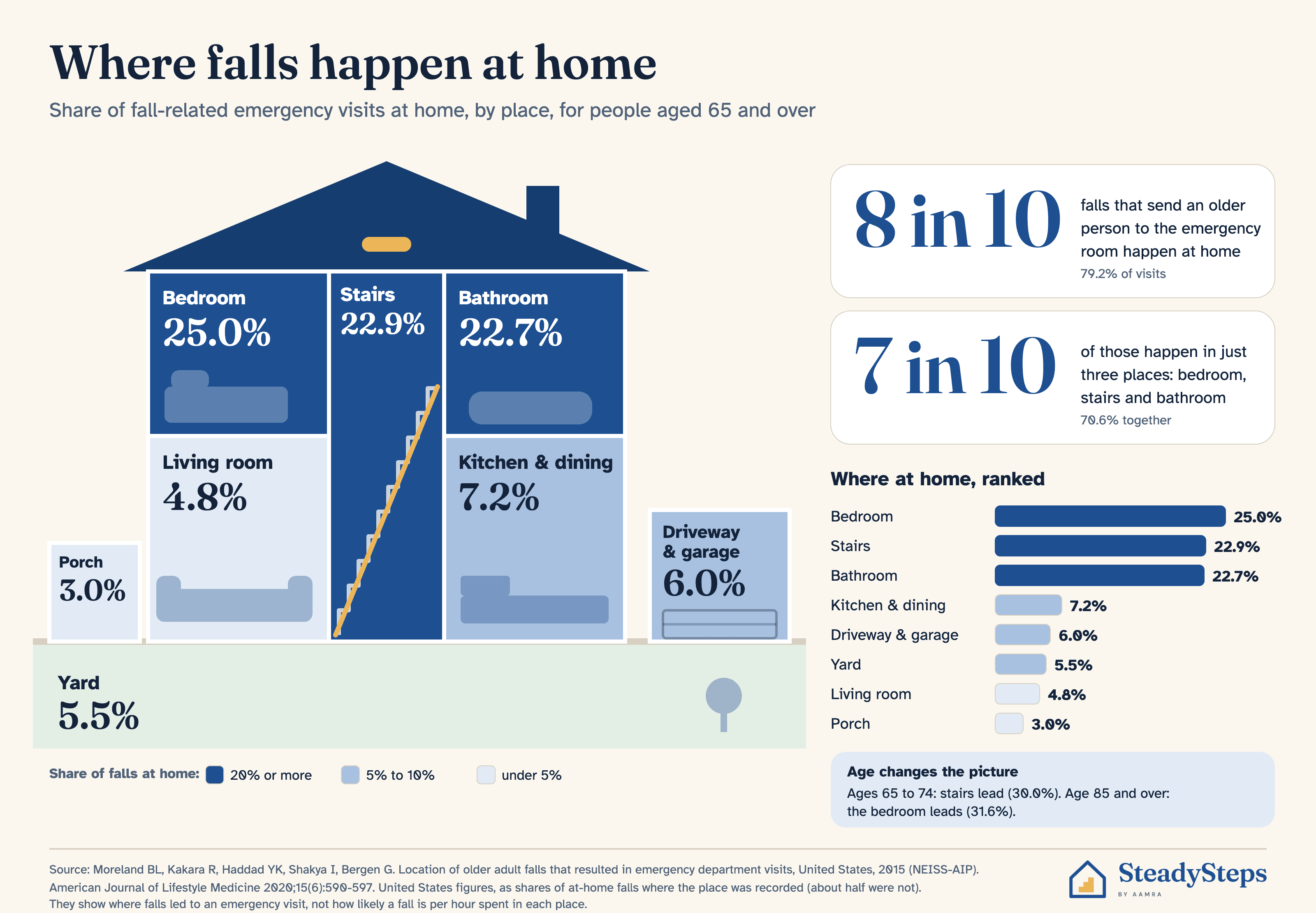
8 in 10
falls that send an older person to the emergency room happen at home
79.2% of visits
7 in 10
of those happen in just three places: the bedroom, the stairs and the bathroom
70.6% together
Where at home, ranked
- Bedroom25.0%
- Stairs22.9%
- Bathroom22.7%
- Kitchen and dining room7.2%
- Driveway and garage6.0%
- Yard5.5%
- Living room4.8%
- Porch3.0%
Ages 65 to 74: stairs lead (30.0%). Age 85 and over: the bedroom leads (31.6%).
See the figures as a table
| Place | Share of falls at home |
|---|---|
| Bedroom | 25.0% |
| Stairs | 22.9% |
| Bathroom | 22.7% |
| Kitchen and dining room | 7.2% |
| Driveway and garage | 6.0% |
| Yard | 5.5% |
| Living room | 4.8% |
| Porch | 3.0% |
The good news
Many falls can be prevented.
Falls have causes, and many of those causes are in the home: in the rooms, the routes and the routines your parent uses every day. When a home is looked at carefully by someone who knows what to look for, and put right, fewer people fall.
38%
fewer falls
among older people at higher risk of falling who had their home assessed and changed (Cochrane review, 2023, as reported by WHO). Exercise lowers falls by about 23%.
You cannot be there at 2 a.m. Your parent’s home can be.
A SteadySteps visit takes about two hours. You get a clear report within 24 hours, you choose what to do, and our own team does the work in one visit.
Read more from Aamra’s doctors.
- Why Seniors Fall: The Clinical Prevention Guide
- Is Your Apartment Safe for Your Parents? A Fall Risk Guide
- Stay active, stay safe: Boosting mobility and preventing falls in seniors
- Functional Balance in Seniors
Not sure where to start? Check your parent’s fall risk. A short, free self-assessment from Aamra. A good first step, before you look at the home.
Sources
- WHO: Falls (fact sheet)
- Thakkar, Muhammad and Srivastava, PLoS One 2022: falls among older Indian adults, LASI 2018
- Moreland and colleagues, American Journal of Lifestyle Medicine 2020: location of older adult falls that resulted in emergency department visits, United States, 2015
- George and colleagues, Chinese Journal of Traumatology 2023: excess mortality in elderly hip fracture patients, an Indian experience
The figure for India is what older adults reported themselves over two years, so it is not a count of every fall. This page is general information and does not replace medical advice.